What is going on?
Q?
Future proves Past
Be strong (anons)
What is going on?
Q?
Future proves Past
Be strong (anons)
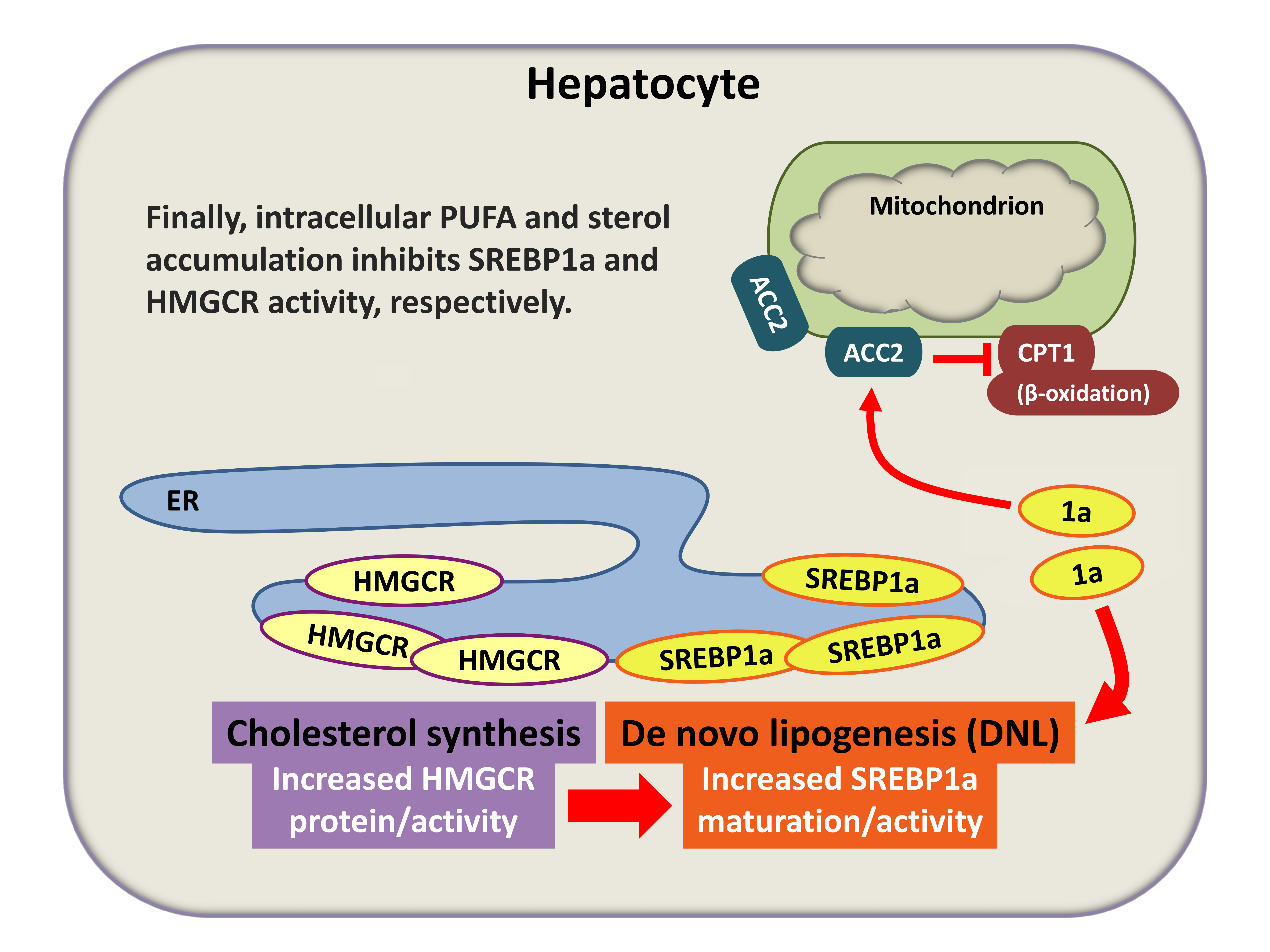 HMGCR-dependent SREBP1a maturation (simplified scheme). 1a, mature SREBP1a protein; ER, endoplasmic reticulum. (see section »PXR versus LXR«)
The dogma of the SREBP1 protein:
»Sterols inhibit the cleavage of the precursor, and the mature nuclear form is rapidly catabolized, thereby reducing transcription.« (see ref 1, ref 2, ref 3)
However, with all due respect, I would like to mention that the results of dozens of scientific articles contradict and/or do not support this dogma. The literature analysis on srebp1a.com and the results of the following mentioned article reveal it.
Before the literature analysis on srebp1a.com and the analysis of the article mentioned above, please consider the following two points:
1. HMGCR is the rate-limiting enzyme of sterol biosynthesis.
2. HMGCR protein/activity induces the maturation of SREBP1.
Alarming predictions:
Abstract
Nonalcoholic fatty liver disease (NAFLD) and resulting nonalcoholic steatohepatitis (NASH) are highly prevalent in the US, where they are a growing cause of cirrhosis and hepatocellular carcinoma (HCC), and increasingly, an indicator for liver transplantation.
A Markov model was used to forecast NAFLD disease progression. Incidence of NAFLD was based on historical and projected changes in adult prevalence of obesity and type 2 diabetes mellitus (DM). Assumptions were derived from published literature where available, and validated using national surveillance data for incidence of NAFLD-related HCC. Projected changes in NAFLD-related cirrhosis, advanced liver disease, and liver-related mortality were quantified through 2030.
Prevalent NAFLD cases are forecasted to increase 21%, from 83.1 (2015) to 100.9 million (2030), while prevalent NASH cases will increase 63% from 16.52 to 27.00 million cases. Overall NAFLD prevalence among the adult population (aged ≥15 years) is projected at 33.5% in 2030, and the median age of the NAFLD population will increase from 50 to 55 years during 2015-2030. In 2015, approximately 20% of NAFLD cases were classified as NASH, increasing to 27% by 2030, a reflection of both disease progression and an aging population. Incidence of decompensated cirrhosis will increase 168% to 105,430 cases by 2030, while incidence of HCC will increase by 137% to 12,240 cases. Liver deaths will increase 178% to an estimated 78,300 deaths in 2030. During 2015-2030, there are nearly 800,000 excess liver deaths.
With continued high rates of adult obesity and DM, and an aging population, NAFLD-related liver disease and mortality will increase in the US. Strategies to slow the growth of NAFLD cases and therapeutic options are necessary to mitigate disease burden.
Source: HEPATOLOGY
One further newly published peer-reviewed article:
Tajima-Shirasaki et al. Eicosapentaenoic Acid Downregulates Expression
of the Selenoprotein P Gene by Inhibiting SREBP-1c Independently of the AMPK
Pathway in H4IIEC3 Hepatocytes. J Biol Chem. 2017 May 2. pii: jbc.M116.747006.
Introduction:
According to the purpose of the study, it was the aim to find out if hepatic SREBP1c induces the transcripition of SELENOP eicosapentaenoic acid (EPA)-dependently or rather if EPA, a polyunsaturated fatty acid (PUFA), inhibits the activity of SREBP1c.
Evaluation:
Without going into great detail, it is useful to consider the following three issues:
While Cho et al. have written a modern article in regard to hepatic SREBP1a, it may well be that Rong et al. (“Horton Lab”) have done everything to maintain the conventional view about SREBP1c and SREBP1a in hepatic lipogenesis.
*** First article: Cho et al. ***
Statements:
»…the 12 mg/kg ENOblock treatment decreased the serum level of free fatty acid compared to untreated db/db mice (Fig. 2G). This could be due to the observed inhibition of Srebp-1a and -1c, which are key regulators of lipid homeostasis.«
»ENOblock treatment normalized Srebp-1a expression to the level observed in normal B6 mice and also reduced the expression of Srebp-1c (Fig. 3R,S).«
*** Second article: Rong et al. ***
The following statements must be considered very critically:
Evaluation of statement 1:
In my opinion, the title is not supported by the results – Au contraire:
Evaluation of statement 2:

Mary K. Bennett, Timothy F. Osborne and co-authors nailed it:
»Although the existence of gene families and overlapping mRNAs in higher eukaryotes has been known since the 1970s, the extensive clusters of highly related genes and the almost ubiquitous nature of alternative mRNA processing was not fully realized until the sequence of the human genome was reported 7 years ago. The sequencing of genomes from several other species has confirmed this as a basic feature of all complex eukaryotic organisms. Thus, a major goal now is to define precisely the unique and common roles for the different proteins produced from overlapping transcripts and for closely related proteins in the same family. This is complicated when the proteins are co-expressed in the same cells and function as dimers/multimers in which the individual molecules can form homo- or heteromers as in the case of the mammalian SREBPs.« [Bennett et al. Selective binding of sterol regulatory element-binding protein isoforms and co-regulatory proteins to promoters for lipid metabolic genes in liver. J Biol Chem. 2008 Jun 6;283(23):15628-37.]
2 decades ago, Nobel Laureates Goldstein & Brown discovered SREBPs (SREBP1a, SREBP1c and SREBP2) as key transcriptional regulators of lipid metabolism. However, until January 2016, one year ago, the only "synonyms" for the SREBF1 gene were SREBP1, bHLHd1 and SREBP-1c (provided by NCBI and HGNC). SREBP1a could not be found! This “mistake” was corrected in February 2016, after I have mentioned it. See here: NCBI and HGNC.
Not only SREBP1c, also SREBP1a is a transcript of SREBF1 and SREBP-1c is NOT a synonym for SREBP1a.
| Next > |